
- Home /
- Tech Talent & Hiring /
- The 2027 Campus Pipeline Is Already Different: Four Signals Hiring Leaders Cannot Ignore
Tech Talent & Hiring
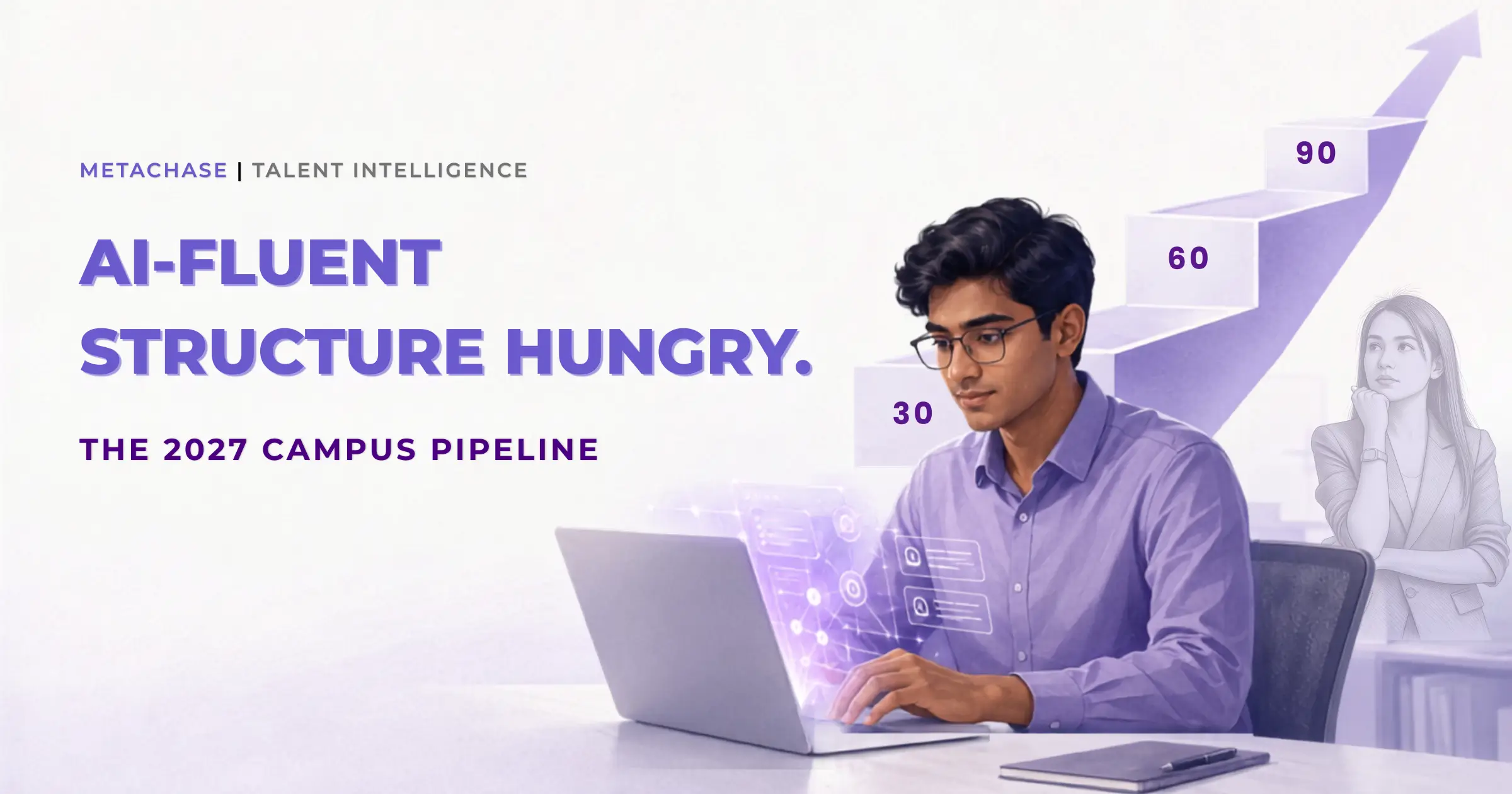
THE 2027 CAMPUS PIPELINE IS ALREADY DIFFERENT
Four signals hiring leaders cannot ignore
A 71-response workshop study suggests early-career talent may be less stability-led, more AI-assisted and more structure-hungry than standard campus playbooks assume.

The contradiction campus hiring leaders need to understand
The early-career candidate entering your 2027 pipeline may ask AI before asking a manager and still want detailed, step-by-step direction when work becomes complex.
That is not inconsistency. It is the central design challenge for graduate hiring: information independence is rising faster than workplace judgment. Young talent can retrieve answers quickly, but retrieval is not the same as understanding context, navigating ambiguity or knowing what good work looks like inside your organisation.
MetaChase saw this tension in July 2026 while conducting a proprietary assessment at the Youth Career Workshop at YMCA Mumbai. Across 71 responses, four signals stood out. Each one challenges a familiar assumption in campus attraction, selection or onboarding.
A note on the data
Signal 1: Learning velocity is a stronger proposition than stability
When respondents selected what motivates them, 61% chose learning and growing. Only 6% selected stability and security. Learning finished more than ten times ahead of stability in this cohort.
The immediate lesson is not that pay, brand or security no longer matter. It is that these may be threshold factors rather than the reason a candidate becomes interested. A campus pitch led by company history, CTC and permanence can sound safe without sounding developmental.
For the 2027 campaign, make the first-year learning journey visible. Show candidates what they will know, build and own after 30 days, 90 days and 12 months. Replace generic promises such as “fast growth” with evidence: manager access, project exposure, certifications, review cadence, internal mobility and examples of responsibility earned by previous graduates.
The offer is not only a job. It is a credible increase in capability.
Signal 2: AI has become the first layer of support
When stuck, 41% of respondents said they turn first to AI or online tools. By comparison, 21% first ask a teacher or mentor, while 7% first ask peers.
Many onboarding programmes are still designed around information transfer: a buddy explains the system, a senior answers repetitive questions, and the new hire slowly learns where knowledge lives. That model now competes with an always-available answer engine.
The right response is not to fight the behaviour or assume every AI answer is reliable. It is to redesign the ramp-up around it. Let AI handle searchable information, practice prompts, policy retrieval and low-risk rehearsal. Use managers and senior colleagues for the work only humans inside the organisation can do well: explain trade-offs, demonstrate judgment, challenge assumptions, interpret culture and review consequences.
Employers should also set explicit AI-use boundaries from day one: what may be entered into external tools, what must be verified, which tasks require human review and how sources should be documented. AI fluency without governance creates speed without control.
Signal 3: Digital fluency is not the same as workplace autonomy
Seventy percent of respondents wanted detailed, step-by-step guidance when starting a complex task. At first glance, that appears to conflict with AI-first problem-solving. In practice, the two behaviours fit together.
AI helps someone begin. It does not automatically tell them which constraints matter, how much initiative is appropriate or what acceptable quality looks like in a specific team. Entry-level employees often need structure around the work even when they are highly resourceful inside the task.
A better first 90 days therefore combines structure with a visible path to independence:
- Days 1-30: Provide clear task sequences, examples of good work, AI-use rules and frequent feedback.
- Days 31-60: Reduce instructions, introduce controlled ambiguity and ask the employee to explain decisions.
- Days 61-90: Assign an outcome rather than a process, while retaining review gates for risk and quality.
The goal is not permanent hand-holding. It is an autonomy ladder that tells a new hire how independence will be earned.
Signal 4: Technology can no longer assume default preference
Interest in Technology and Engineering averaged 2.55 out of 5 across eight career fields, and 35% of respondents gave it the lowest possible rating. Within this sample, a technology career was not the automatic aspiration that employers may expect from digitally comfortable students.
This does not mean India lacks technology talent. It means employers cannot treat awareness, interest and application intent as the same thing. A student may use AI every day without seeing a technology role as meaningful, creative or accessible.
Employer brand must therefore begin before the placement-cell announcement. Show the human problems behind technical work. Let practitioners demonstrate what they build, who benefits and how a beginner contributes. Use workshops, project challenges, faculty partnerships, alumni stories and role previews to create informed interest before asking for an application.
What should change before the 2027 campus drive?
- Rewrite the campus value proposition around learning. Make the 12-month capability gain concrete and provable.
- Design an AI-augmented onboarding system. Give new hires safe ways to use AI, and reserve human time for context, judgment and coaching.
- Build a 30-60-90-day autonomy ladder. Start with explicit structure, then deliberately remove it as competence grows.
- Engage before placement season. Create career interest through useful experiences, not only employer-brand claims.
- Measure the first year, not only offer acceptance. Track joining ratio, time to first independent outcome, manager confidence at day 90, regrettable attrition at 6 and 12 months, and internal mobility.
The real risk is using an old playbook on a new pipeline
Campus hiring teams often optimise the visible part of the funnel: registrations, tests, interviews, offers and joins. The larger risk sits after the joining date. If the role is sold as stability but experienced as stagnation, or if an AI-fluent fresher is mistaken for a self-directed professional, the organisation pays for the mismatch in manager time, productivity and early attrition.
The 2027 cohort does not need less human support. It needs human support used differently. Information can increasingly be self-served. Structure, judgment, feedback and a believable path to growth cannot.
How to test these signals inside your own organization
Before redesigning the full programme, run a simple evidence check across your last graduate cohort and your next applicant pool:
- Ask candidates to rank learning, compensation, brand, role content and stability, then compare the result with the messages used in your campus presentation.
- At days 30 and 90, ask new hires where they go first when blocked: manager, buddy, peers, internal knowledge base, search or AI.
- Ask managers which gaps consume the most coaching time: information, tool use, judgment, communication, prioritisation or confidence.
- Compare offer acceptance and joining ratios with six- and twelve-month retention. A persuasive campus pitch is only effective if the employment experience keeps the promise.
One question for hiring leaders
About the Author

Joel Mac
Founder & CEO
Joel brings a seasoned perspective to the MetaChase mission, blending deep industry insight with a relentless drive for excellence. With a focus on architectural integrity in recruitment, he bridges the gap between high-level corporate strategy and the human element. For Joel, the "Gold Standard" isn't a goal, it's the baseline for every partnership he builds.